Pride of Place
25th January, 2012
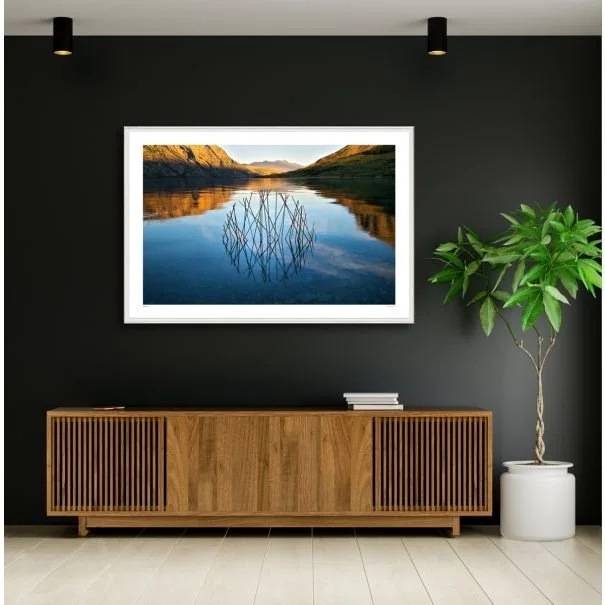
Three prints of sculptures from Martin Hill – Fragile Canvas exhibition at Gallery Thirty Three now have pride of place at Wanaka’s premier luxury lodge Whare Kea. Warm thanks to owners Martyn and Louise Myer for their support.
Recent high points
11th January, 2012
Our friend Len Gillman agreed to join us on the Fine Line Expedition to Baffin Island, and a team of three made it a safer proposition to hike for two weeks in an Arctic wilderness among glaciers, big rivers and huge granite walls. His good humour and mountain skills helped make it an unforgettable experience. Throughout the year we made many journeys into wild locations where we created many sculptures in the company of James Blake and Joey Bania who filmed our progress. The resulting 25 minute documentary was edited from 100 hours of footage. “A Delicate Canvas ” premiered at the Regent Theatre in Dunedin as part of ScienceTeller Festival and drew a large enthusiastic audience. An exhibition of the works featured at Gallery 33 in Wanaka Presenting the Fine Line Project at ScienceTeller Festival along with the exhibition Fragile Canvas at Otago Museum had me spending many hours at the computer but we now have a comprehensive documentation of the Fine Line Project so far. This will form the basis for development into an audio visual with video and interviews added. The year was wrapped up with a climb of Mt Sealy near Mt Cook by Martin and an overnight hike with Philippa and friends in the Matukituki valley where we walked on an ice bridge beneath a great waterfall. In the past two weeks we have rock climbed on the Remarkables high above Queenstown including an ascent of Single Cone, climbed the Shotwell Slabs in the Darren Mountains of Fiordland and camped on Gertrude Saddle where a snow sculpture was made. Reflecting on a year of hard work and profound experiences I can’t help wondering what 2012 will bring

Martin on the summit of Mt Sealy. MT Cook beyond
Fragile Canvas at ScienceTeller
14th November, 2011
The body of work that was made for the Fragile Canvas exhibition was also the subject of a documentary film by Joey Bania and James Blake and it premieres on the 16th November at the Regent Theatre as part of the ScienceTeller festival in Dunedin.
Martin Hill Fragile Canvas will be exhibited at the Otago Museum 1877 Gallery during ScienceTeller and I will be giving a talk / audiovisual also on 16th November as part of the festival programme.
I hope these events give people not only a chance to see the exhibition prints which are for sale, but to also learn about the philosophy and working practice that leads to the work.
Philippa and I will be present at ScienceTeller for its duration.
http://www.scienceteller.com/speakers.html
Fragile Canvas sculpture prints pop up in Christchurch
14th October, 2011
With the success of Martin Hill – Fragile Canvas exhibition in Wanaka the directors of the Arthouse in Christchurch are exhibiting four of the works in Pop Up II which opens Tuesday 18 October and runs till the 23rd.
Philippa and I are pleased with their support for this work and glad that the long suffering residents of earthquake-torn Christchurch will be able to experience it too.
Pop Up II exhibition can be seen here: http://www.thearthouse.co.nz/exhibitions/71/Pop-Up-II.htm
Gallery 33 Wanaka, Martin Hill – Fragile Canvas complete exhibition and essay: http://www.gallery33.co.nz/whats_on.html?id=142
Interwoven World. 2011 750 x 500 Edition 10
The show goes on
4th October, 2011
A solo exhibition opening at Gallery 33 in our home town of Wanaka was a very special event because many friends and art lovers attended. There was a party atmosphere with plenty of positive feedback about the work.
The film makers were there to capture it all on film and wrap up their story of our year’s sculpture-making in the local environment. For Philippa and I it was a satisfying culmination of a year’s continuous creative activity.
Martin Hill – Fragile Canvas will also be exhibited at the Otago Museum from 16th to 19th November as part of Otago University Science Teller Festival along with the premiere of the film “Fragile Canvas” by James Blake and Joey Bania on 16th November at the Regent Theatre, Dunedin.
With such a positive response we intend to exhibit Martin Hill – Fragile Canvas in other venues so enquiries from galleries are welcome.
Warm thanks to Melissa Reimer and her team at Gallery 33 Wanaka.
Melissa’s essay and the limited edition prints can be viewed here:
http://www.gallery33.co.nz/whats_on.html?id=142
Fragile Canvas
17th September, 2011
Since we returned from making the Fine Line Sculpture on Baffin Island
up in the Arctic we have directed our efforts into working towards Fragile Canvas,
a solo exhibition at Gallery 33 in our home town of Wanaka.
Since the winter snow came late this year we had made no works using snow or ice before we left for the Arctic. As soon as we got back we hiked with the film crew up to Breast Hill through the snow to photograph and film the stone sculpture we had made in February, now in winter conditions.
Thick ice had also formed on Diamond Lake so we set to work with ice axes to cut out a big disc out of it. We managed to lever it onto the surface and sculpt it but it froze in place and when we attempted to lift it into position it cracked and broke. The film crew were delighted: failure makes interesting film footage!
The next day the film makers left and undaunted Philippa and I went back to the lake to try again and we completed and photographed the ice sculpture as we had intended it to be.
Since then I have worked solidly on selecting and preparing the sculpture images to make the prints for the exhibition which previews on Friday 23 September. This series of works made throughout the seasons of this year in the Wanaka region represents for us a chance to express not just our love for this fragile place where we live, but a love and concern for the fragile canvas of the biosphere that nourishes us all.
http://www.gallery33.co.nz/artworks.php?artist_id=213
Call of the wild
4th September, 2011
From the moment we stepped ashore at the head of Pangnirtung Fiord in Baffin Island in Canada’s far north territory of Nunavut and the sound of the boat dissolved among the waterfalls we felt alone in an ancient primal land controlled completely by the forces of nature. Loaded with more than we could carry we were forced to repeat each day’s journey two more times for the first four days in order to ferry loads.This way we experienced the landscape under different conditions as the weather changed constantly and unexpectedly from sunshine to gale force winds and rain. Rivers rose and fell within hours making crossings dangerous, and avalanches of rock poured down thousand meter rock walls. Camping each night meant finding a huge rock to shelter us and flat ground that was safe from flood. Polar bear safety required stashing food and fuel well away from our camp.
The sheer scale of the Weasel Valley is hard to comprehend with granite walls that tower above us for a thousand metres capped by glaciers hundreds of metres thick. The valley floor has no trees, the tallest shrub being a low growing Arctic willow. When the ice and snow melts in the brief summer months the exposed tundra is covered with flowering plants, Arctic geese fly in formation overhead and eider ducks flock at the river’s edge. The remains of caribou antlers and tracks of other creatures show us that there is life here but we saw little except a lone peregrine falcon.
One of the most inspiring peaks is Thor named after the god of thunder by the Inuit people who have inhabited Baffin Island for 4000 years. The overhanging west face is one of the tallest and home to one of the hardest climbs in the world. The peak’s shape is so dramatic we wanted to make The Fine Line Sculpture in its shadow. This is a land dominated by ice so we were excited to find that some of the winter ice still remained in the coldest part of the valley shaded by the walls.
Although the ice was very thick it was melting at the edges where the rocks absorbed sunlight. Here it was possible to cut off and shape a piece about 1.5m across using our ice axes and with much effort, especially from Len, move it to a suitable site on the ice sheet. We had little time to get the shape right before the sun dipped behind the giant peak of Odin to the west. Since the sun never actually sets here above the arctic circle in summer its golden light touched the high peaks for some time giving me the opportunity to photograph and film the glorious spectacle.
Some days later we had made our way to Summit Lake, climbed up onto the Caribou Glacier and camped on ice beneath the mighty flat topped towers of Mt Asgard. A day or two of clear weather meant this was a highlight of the expedition and a chance to experience the high Arctic terrain I had dreamt of for so long.
The return journey with our heavy loads was punctuated by severe storms, difficult river crossings and a transformed landscape.
The friendly Inuit family with whom we stayed in Pangnirtung told us that the rainfall is the worst for decades and that the annual winter ice festival last Christmas was the first they have held using boats because there was no ice on the fiord.
Our flight out was cancelled and we hitched a ride on a rescue helicopter returning to base after evacuating those in the mountains affected by the severe weather and a polar bear sighting. Flying low across the vast Arctic wilderness of Baffin Island for hours we saw no human habitation only endless rock and tundra interspersed with lakes and patches of remnant ice, as wild as any place can be.
Baffin Island Fine Line Expedition
14th June, 2011
With global warming causing the warmest autumn in New Zealand for 150 years,
and earthquakes causing devastation in Christchurch, we are preparing for an expedition to the Arctic wilderness of Baffin Island where it has been said the last ice age began. The vast Penny Ice Cap that covers most of the island is reported to be shrinking as is the Greenland ice cap.
What conditions will we find there now?
Our plan is to go by boat to the head of Pangnirtung Fiord where our Inuit outfitter will drop us. Carrying everything we need for two weeks hiking and climbing to a high point we will make the ninth of twelve environmental sculptures that will eventually comprise The Fine Line Project encircling the earth.
Joining us on the team with Philippa and I is Len Gillman head of the School of Applied Sciences at AUT in Auckland, New Zealand, and longtime climbing friend. We will walk up the Weasel Valley in Auyuittuq National Park to reach Mt Asgard passing some of the greatest rock walls on the planet including Thor Peak with its overhanging wall of 900 metres.
We will need to double carry loads for the first few days to Thor Peak where we will set up a base camp before embarking on a side trip up glaciers to make the sculpture. We will continue up the Weasel Valley to reach Summit Lake, the Turner Glacier and Mt Asgard. We also intend to climb at least one of the peaks.
Although it will be summer we can expect freezing temperatures, difficult river crossings and high winds. Hopefully we won’t meet any polar bears.
Seed of an idea
20th March, 2011
Filming the making of an environmental sculpture on top of a classic rock pinnacle near Wanaka was serious fun. We climbed Tomb Stone Crack to reach an airy platform and hauled up the film gear and set it up. James, one of the film crew climbed the crack to film on top while Joey found good angles from below and on other rock outcrops.
The sculpture was made from rosehips gathered from the wild briar growing on the hillside below. They are an invasive weed here in Central Otago but were a useful seed for our idea. The bright red of the sculpture shone against the lichen covered rock and surrounding crags.
We took the rosehips home with us and that night Philippa turned them into rosehip syrup and cooked pancakes with cream and rosehip syrup. Delicious!
On the edge.
21st February, 2011
In a two day clear weather window last week Philippa and I made it to this high location with our friendly crew who filmed our efforts making a sculpture from thin slabs of schist gathered from the tops.
We are indebted to Tom and A Rowley of Lake Hawea Station for inviting us to use their farm road for access to reach this vantage point and to camp overnight there looking out towards the Southern Alps.
We intend to return with the film crew to photograph and film the sculpture through the changing seasons.
Here film maker Joey Bania gets up close using a digital SLR video camera.
Life is rich: experiences over the last few weeks
7th February, 2011
CLIMBING MT AVALANCHE
I had been wanting to climb Mt Avalanche in Mt Aspiring National Park ever since I first wandered up the beautiful Matukituki valley thirty five years ago on arrival in New Zealand from UK.
Its symmetrical shape and triple peaks above Avalanche Glacier crown the junction of the East and West Matukituki valleys and are visible from parts of Wanaka where we now live.
An invitation from climbing friends was too good to pass up and we were away the next day. The long plod up the valley to Pearl Flat and a steep climb through beech forest and tussock took us to French Ridge hut in about seven hours.
We had been experiencing strange low cloud effects for a week but hoped the next day would be clear. It wasn’t. Leaving the hut at 4.30 am we made good progress up onto the Quarter Deck in heavy cloud. At dawn a pinkish cast entered the scene and suddenly there was visibility. Stretching above us was our glacier route to the Bonar glacier and above and to the right our objective, the West Ridge of Avalanche, dark and free of snow. Below us a sea of cloud filled the valley.
After a couple of hours’ careful route finding through crevassed ice, we broke out onto the Bonar glacier to a perfect clear view of Mt Aspiring’s south face and the SW ridge on which two years before I had suffered a terrible experience when my friend John fell to his death. I was glad to return but it was with great sadness that I reflected on that day and the loss of a great friend.
Crossing the glacier we made good progress on firm snow up to the foot of the rock slabs that run up to the high peak of Avalanche. Leaving our ice gear at the schrund we climbed the rough weathered rocks past huge exfoliating flakes following deep cracks.
The climbing was easy but often loose with big drops to the glaciers on all sides. No room for mistakes here.
The summit consists of spectacular broken rocks balanced above huge drops towards the Kitchener cirque with its icy blue lake far below and still further down the East Matukituki river winding its way towards Wanaka. The two lower peaks stood out in front of us with sharp jagged ridges bristling with gendarmes connecting the summits but barring access.
Mt Aspiring shone majestically across the Bonar glacier, its summit still hundreds of metres above us.
Warm conditions allowed us a rest and some lunch on top before abseiling back to the schrund and a hot plod across the glacier in full sun before following our footsteps carefully across snow bridges over crevasses to the safety of French Ridge below and the comfort of the hut, a meal and a sunset to remember.
DOCUMENTARY FILMING BEGINS
The next day after a long and tiring decent to Wanaka a film crew arrived for two days shooting towards a year long documentary featuring our sculpture work. It looked like rain so Philippa and I made a hurried plan to make a sculpture on the shingle river banks of the Matukituki River near the West Wanaka estuary into the lake.
The film crew were surprised to find that we where going to make a sculpture simply using river water on the dry river bank.
After carefully marking out its position using a stick tied to a string we began to fetch water in buckets and pour it onto the gravel beach. It proved to work well and took less time than we imagined to draw a dark grey circle twenty four metres across.
When viewed from above it had the shape and presence I had anticipated and and I photographed it in overcast light giving plenty of detail in the sculpture as well as the mountain landscape beyond. The wet circle gradually begun to dry out so the crew filmed with time lapse to show it disappearing.
The next day rain was forecast to arrive from the west so we devised a sculpture concept that was about rain.
Gathering dry driftwood from the lake edge we made a work on a shingle beach which would change colour when it became wet. Sure enough right on time the sky darkened and big drops of rain began to spatter the driftwood.
Having filmed and photographed it dry we continued to capture the changing conditions and their effects on the sculpture while protecting the cameras. When fully wet some of the wood took on dark rich colours that increased its contrast with the beach. The flat light gave an evenness to the range of tones so that the camera could capture them well.
The film crew returned to the city but next day was very sunny so Philippa and I revisited the sculpture and photographed it in bright sun and also at sunset with the snow covered mountains visible in the background.
SCULPTURE IN CENTRAL OTAGO
The next few days where spent making final preparations for a sculpture exhibition for which I had to install a steel work 2m x 2m titled Cyclic Flow. The site is in the park like setting of Rippon Vineyard overlooking Lake Wanaka.
Sculpture in Central Otago is a biennial show of selected sculpture works installed along a 1.5 k walk through one of the most scenic vineyards in the world. The installation went without a hitch and the exhibition opened with a gala dinner in the new Rippon event centre positioned on a hill above the vineyard – a spectacular venue built with rammed earth walls and recycled timbers.
Today I returned there to give an artist talk and enjoy the sculptures of the 35 artists involved along with live music.
The sculptures remain on show for three months.
Next week I go to sign up for my pension. Retirement however, is not on the agenda.
Sense of Wonder
12th January, 2011
We have just returned from a trip into the mountains in perfect weather with two dear friends. They were introducing their delightful 7 year old daughter to
multi-day tramping in the wilderness of the Southern Alps of New Zealand.
For Philippa and I it was a privilege to make this journey in the company of a family with whom we have shared so many adventures over the years.
It is becoming increasingly difficult for people to have meaningful contact with the natural world so it is immensely rewarding to witness one family purposefully introducing their daughter to the mountains. Carrying her own small pack and climbing happily up steep terrain for hours Sammy still had energy to run through the tussock and marvel at alpine flowers and the native kea, New Zealand’s mountain parrot. Gazing at the high peaks and glaciers, she absorbed it all as naturally as she does the digital world she lives in daily.
Thank you David, Jeong-hee and Sammy for sharing your sense of joy and wonder with us.
Change for good
24th November, 2010
This month a new programme of tools for sustainable practice in business was launched for New Zealand and Australia by the Sustainability company in Christchurch featuring Martin Hill environmental sculptures.
Sculptures are now on flickr
12th November, 2010
I have just uploaded a collection of sculpture photographs to Flickr in order to share them with a wider audience. I will from time to time add to the collection as new works are produced so please enjoy them and come back. Comments and feedback are welcome.
Interconnected systems
11th November, 2010
I am working on new sculptures both in the landscape and in the studio about ideas concerning intersecting and interconnected systems. This interests me because a strong point at which to influence change is where systems connect.
While camping with Philippa this week on the bank of the Arawhata River estuary on the West Coast, I was struck by the relationship of the rain forest to the constantly changing river as it rises and falls according to the rainfall in the mountains. I believe recognising the effects of the design of human systems on interconnected natural systems is the starting point for actions for change.
Below is the finished sculpture titled “Intersecting Raupo Sticks”. Made with raupo stems tied with strips of flax fiber.
Pisa Range sculpture
5th November, 2010
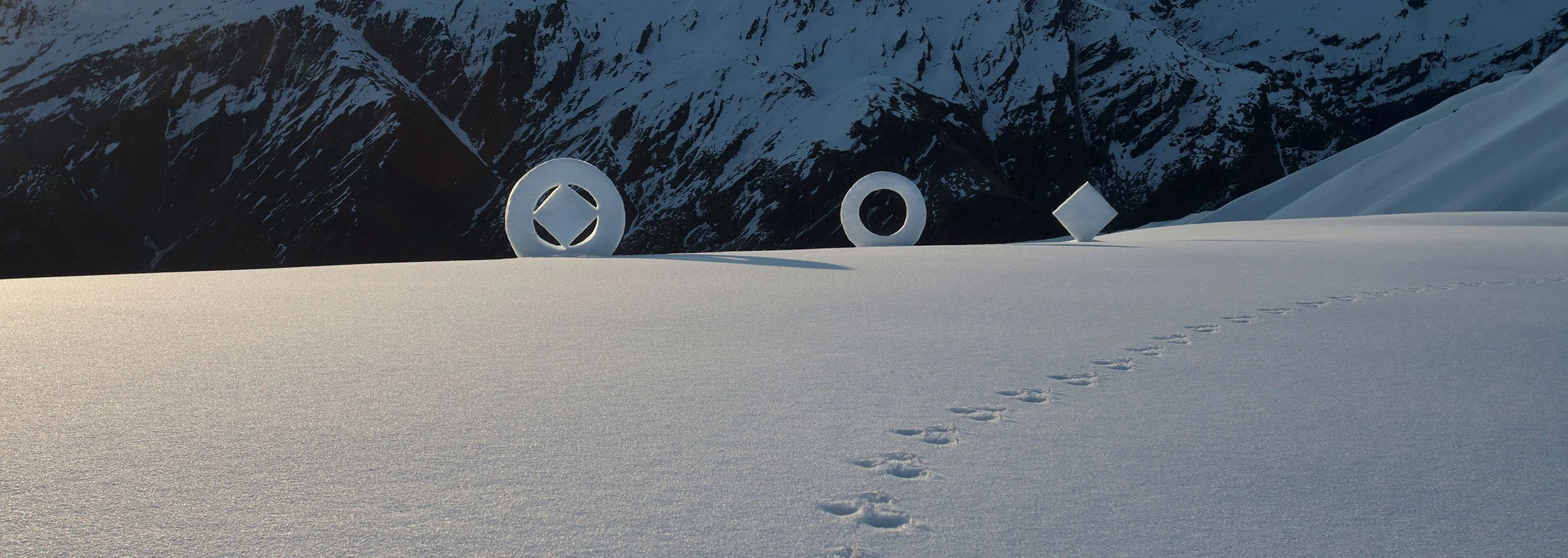
A week after the ski season ended Philippa and I made a journey using snowshoes and pulling our gear on sleds to Bob Lee Hut, where we made a snow sculpture overlooking the Southern Alps including Mt Aspiring. With no cloud or wind the moon rose as the sun set, casting a warm blush across the snow.
Titled Intersecting Circles, it consists of two snow discs meeting at right angles and refers to the relationship between interconnected systems.

Mt Kenya Fine Line Project sculpture completed
1st August, 2010
In June and July 2010 Philippa and I travelled in East Africa riding mountain bikes from Nairobi to Dar es Salaam. Some of the off road tracks took us through territory rarely visited by travellers enabling us to meet with the tribal people of the land and witness wildlife outside game parks.
The main purpose of the expedition was to make the eighth of The Fine Line Project sculptures on one of the peaks of Mt Kenya, Pt Lenana, altitude 4985 metres.
The sculpture was made with the help from our porter James Mwangi Gathoca by gathering frozen snow from patches remaining in the shade of the summit rocks. It was left overnight to freeze again so that it could be shaped before dawn next day when it was photographed.
Due to climate change permanant snow and ice on equatorial mountains like Mt Kenya is disappearing fast. This is bringing devastating consequences to the surrounding ecology and human populations that rely on the water from the mountains.
New Fine Line Expedition
1st June, 2010

We leave on June 3 for an expedition to make another sculpture on our Fine Line Project. It will be the eighth of the twelve sculptures to be accomplished.
To truly experience Africa we are first joining a supported bike tour from Nairobi to Dar es Salaam in Tanzania. This 2 week journey involves mountainbiking 550kms of back roads and tracks.
Interdependence
29th May, 2010
A privately commissioned permanent sculpture was installed on 27 May in a lake on a property on Queenstown. A helicopter was used to airlift the 600kg steel sculpture from Wanaka where it was built by engineering company Metalworks, and lower it into position.
“This large permanent work marks a development in my art practice which is concerned with the relationship between nature and culture. While continuing to make my signature ephemeral works I am also working on a number of other large scale pieces, both as commissions and for public exhibition,” says Martin Hill.
Limited Edition Prints
1st April, 2010

For the first time a selection of Martin Hill works are available as authenticated fine art limited edition prints. To view our Limited Edition Print gallery click here